

Marketplace Plan vs. Health Share: An Honest Side-by-Side Comparison for Colorado in 2027
If you’re paying full price for health insurance, you’ve probably heard a friend say, “I switched to a health share and pay half as much.” Maybe that’s true for them. But a health share isn’t a cheaper version of the same thing. It’s a different thing entirely.
We help clients with both Marketplace plans and health shares, so we don’t have a reason to push you toward one. We just want you to pick the one that fits your family, knowing exactly what you’re trading.
Here’s an honest side-by-side on cost, maternity, pre-existing conditions and more.
The Basics
A Marketplace plan is health insurance sold through Connect for Health Colorado. It has to follow the Affordable Care Act’s rules: it covers a standard set of benefits, can’t turn you down for a health condition, and caps what you pay in a year with an out-of-pocket max. If you qualify, tax credits lower your premium.
A health share is a membership where people agree to share each other’s medical bills. You pay a monthly amount, and when you have a big bill, the group’s money helps pay it. Health shares are not insurance. They don’t have to follow the Affordable Care Act’s rules, and they don’t guarantee they’ll pay any bill.
In Colorado, health shares do have to report data to the state every year, including what members paid in and how much was shared. The Colorado Division of Insurance publishes a summary report, which is worth a look before you join.
Side by Side
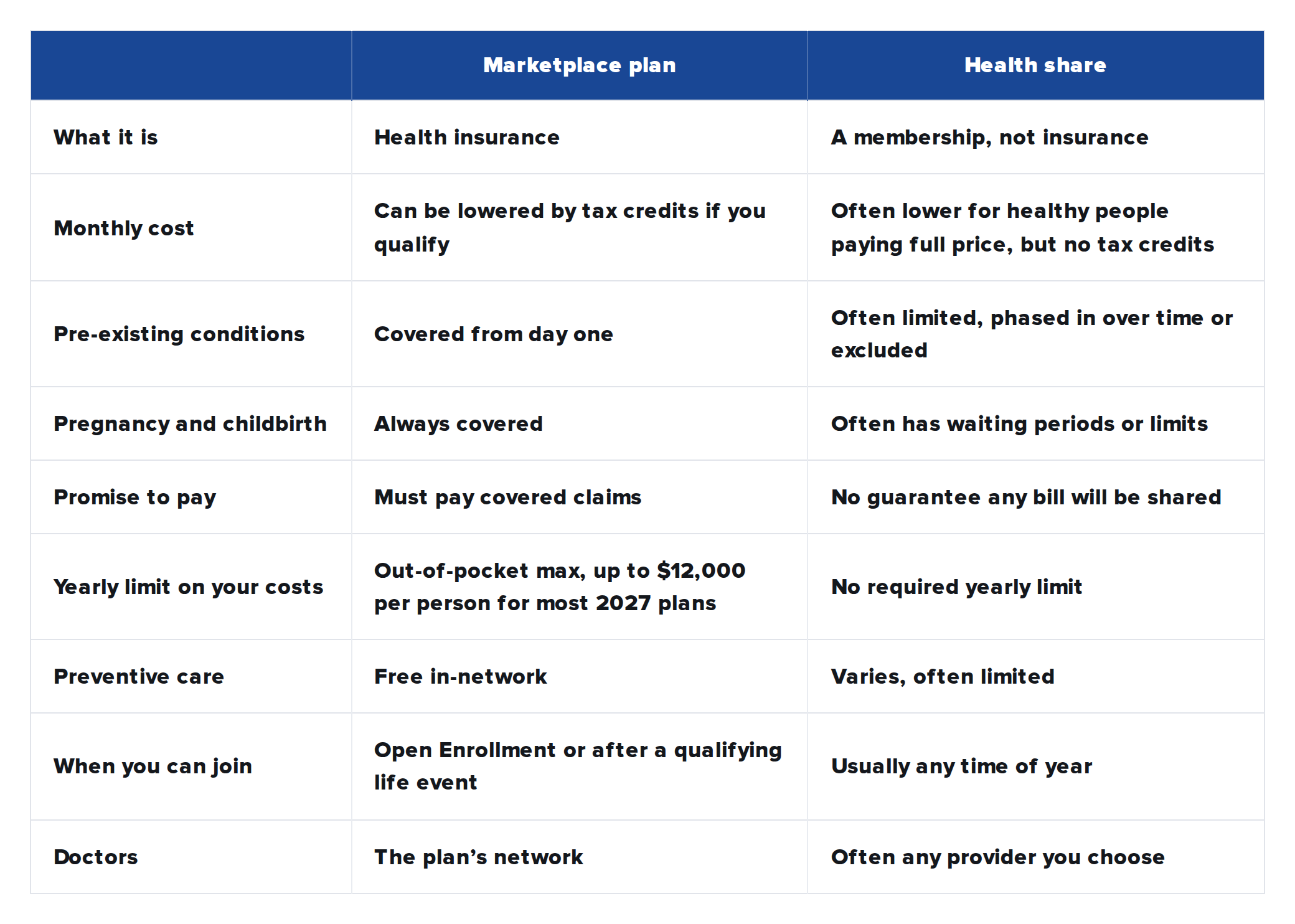
Neither column is “better.” Each one wins in different situations.
Cost: When a Health Share Saves Money (and When It Doesn’t)
A health share is often cheaper when you’re healthy, your household earns more than the tax credit limit, and you’re paying full price for a Marketplace plan. For 2027, that limit is about $63,840 for one person and $132,000 for a family of four.
A Marketplace plan is often cheaper when you qualify for tax credits. Once those credits are applied, many people pay less for a Marketplace plan than they would for a health share, with far more protection.
Look at more than the monthly price. With a health share, your costs also include:
- The amount you pay before sharing starts. Most health shares have a set amount you pay for each medical need, a bit like a deductible.
- Bills that aren’t shared. Anything the guidelines exclude, like care for certain pre-existing conditions, is yours to pay.
- No safety net on a bad year. Without an out-of-pocket max, there’s no legal ceiling on what a bad year could cost you.
The question isn’t just “which is cheaper this month?” It’s “which one could I afford in my worst year?”
Maternity: The Biggest Difference for Families
Every Marketplace plan covers pregnancy, delivery and newborn care. A pregnancy that started before you enrolled is covered too.
Health shares are different. Many have a waiting period, meaning a pregnancy that begins before you’ve been a member for a certain amount of time may not be shared. Some also cap how much they’ll share for a delivery. If a baby is in your plans for the next year or two, read the maternity rules word for word, or stick with a Marketplace plan.
Pre-Existing Conditions
On a Marketplace plan, a pre-existing condition, like diabetes, asthma, a past cancer or a heart issue, doesn’t change your price or what’s covered.
Health shares commonly limit sharing for conditions you had before you joined. Some phase in sharing over a few years. Others exclude certain conditions entirely. If anyone in your household has an ongoing condition, a Marketplace plan is usually the safer choice.
Which One Fits You?
A Marketplace plan usually fits if you qualify for tax credits, you’re planning a baby, someone in your household has an ongoing condition, or you want a guaranteed limit on a bad year.
A health share may fit if your household is healthy, you earn too much for tax credits, you’re comfortable with the trade-offs, and you have savings to handle bills that aren’t shared.
Before you join any health share, ask:
- How long before pre-existing conditions are shared, if ever?
- What are the maternity rules and waiting periods?
- How much do I pay for each need before sharing starts?
- Is there a limit on how much will be shared for one need or one year?
- How long does it typically take to share a bill?
The bottom line
A health share can be a smart way to save, but only if you go in with your eyes open. For families planning a baby or managing a health condition, a Marketplace plan’s protections are hard to beat.
We’ll lay out both options side by side using your real numbers, including tax credits, health share costs and your worst-case year, so you can decide with confidence.
Book a free call or call 303-225-0073. It’s always free to work with us.