

Cigna Is Leaving Colorado: Your Step-By-Step Plan for 2027 Coverage
If you have a Cigna individual or family plan in Colorado, you’ve probably heard the news: Cigna is leaving the individual market nationwide, and more than 40,000 Coloradans will need a new plan for 2027.
First, don’t panic. This only affects plans people buy for themselves. If you get Cigna through your employer, nothing changes. Your coverage isn’t going anywhere this year, and you have more time than you might think. But there’s one date that really matters if you want to avoid a gap in coverage.
In this post, we’ll walk through who this affects, the dates to know, a simple step-by-step plan, and how to compare your replacement options.
Who This Affects (and Who It Doesn’t)
This affects you if you have a Cigna individual or family medical plan, no matter where you bought it: through Connect for Health Colorado, through Colorado Connect, or directly from Cigna.
This doesn’t affect you if you get Cigna through your employer. Cigna is only leaving the individual market.
This change is about medical plans. If you also have a separate Cigna dental plan, check with Cigna about what happens to it in 2027.
The Dates That Matter
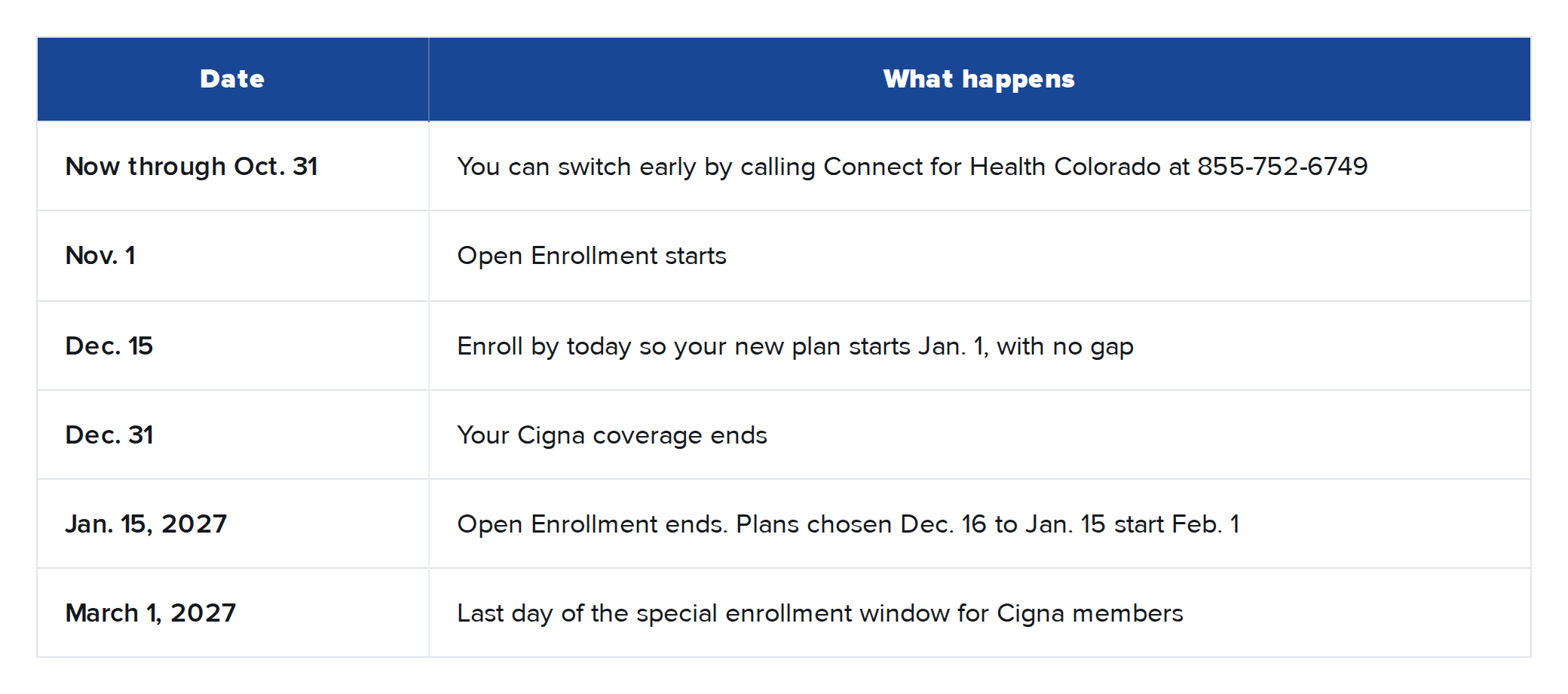
That March 1 deadline is a safety net, not a plan. If you wait past Dec. 15, your new coverage likely won’t start until Feb. 1 or later, and you’d be uninsured in between. Dec. 15 is the date to circle.
Your Step-by-Step Plan
Step 1: Keep using your Cigna plan. Nothing changes for the rest of 2026. If you’ve already met your deductible this year, consider scheduling care you’ve been putting off before Dec. 31. Your new plan’s deductible starts over Jan. 1 either way.
Step 2: Make your list. Write down every doctor, specialist, hospital and prescription your household uses. Add your best estimate of 2027 household income, since that decides your tax credits.
Step 3: See who’s offering plans for 2027. Without Cigna, Colorado’s individual market has six insurance companies: Anthem, Colorado Access (new for 2027), Denver Health Medical Plan, Kaiser Permanente, Rocky Mountain Health Plans and Select Health. Which ones you can choose depends on your county.
Step 4: Compare your options. Use the checklist in the next section.
Step 5: Enroll by Dec. 15, then pay your first premium. Your new plan doesn’t start until the first payment goes through. Once it’s active, cancel any automatic payments to Cigna for January.
How to Compare Your Replacement Plans
It’s tempting to pick whatever looks most like your Cigna plan. But a “Silver” plan from another company can have a very different network, drug list and price. Check these five things:
- Your doctors and hospital. This is the biggest change when you switch companies. Look up every provider on your list in each plan’s directory, or ask us to.
- Your prescriptions. Check that each one is on the new plan’s drug list and what it will cost.
- Referrals. Many Cigna Connect plans didn’t require referrals. Some replacement plans are HMOs that do, so check before you assume you can go straight to a specialist.
- Your worst-case year. Add 12 months of premiums to the plan’s out-of-pocket max. Compare that number, not just the monthly price.
- Your price after tax credits. Your 2027 premium depends on your income and the plans in your area. Don’t assume the same metal level will cost what Cigna did.
Earn too much for tax credits? A Marketplace plan isn’t your only option. For some healthy households, a health share or a fixed indemnity plan can cost less. They’re not the same as insurance, so we’ll walk you through the trade-offs honestly over the phone if you’re interested.
The bottom line
Cigna leaving doesn’t have to be stressful. Keep using your plan through Dec. 31, make your list of doctors and prescriptions, and enroll in a new plan by Dec. 15 so there’s no gap.
We help Cigna members do exactly this every day.
Book a free call or call 303-225-0073. It’s always free to work with us.