

A Freelancer’s Guide to Estimating Your Income for Health Insurance Tax Credits in 2027
When you apply for health insurance through Connect for Health Colorado, one question decides how much help you get: How much will your household earn next year?
If you get a steady paycheck, that’s easy. If you freelance, it’s a guessing game. One month you land three clients, the next month none.
That guess matters more than ever for 2027. Tax credits are paid based on your estimate, then checked against your real income at tax time. Starting with 2026, there’s no longer a cap on how much you may have to pay back if you earned more than you estimated.
Here’s how to make a smart estimate, protect yourself from a surprise tax bill, and what to do when your income changes.
What Counts as Income When You Freelance
The Marketplace doesn’t care what clients paid you. It cares about your modified adjusted gross income, which for most freelancers works out to:
- Your net profit: what clients paid you, minus your business expenses (software, equipment, a home office, mileage and so on)
- Minus a few adjustments: the deductible half of your self-employment tax, plus contributions to a SEP-IRA, solo 401(k) or HSA
- Plus other household income: a spouse’s paycheck, interest, rental income or a side job
That’s why two freelancers who both bill $85,000 can have very different countable incomes. Business expenses and retirement contributions make a real difference.
The tax credit limit for 2027 coverage is about $63,840 for one person and $132,000 for a family of four. If your countable income lands close to that line, every deduction counts.
How to Build Your Estimate, Step by Step
- Start with last year. Pull your most recent tax return and find your net profit from self-employment (Schedule C).
- Adjust for what you know. Add contracts you’ve signed or rate increases. Subtract clients you’ve lost or time off you’re planning.
- Subtract your business expenses. Use last year’s as a guide, then adjust for new costs like equipment or software.
- Subtract your adjustments. Half of your self-employment tax, plus any retirement or HSA contributions you’ll actually make.
- Add other household income. Include a spouse’s wages and anything else your household earns.
Here’s an example. Say you’re a single freelance designer living in Longmont:
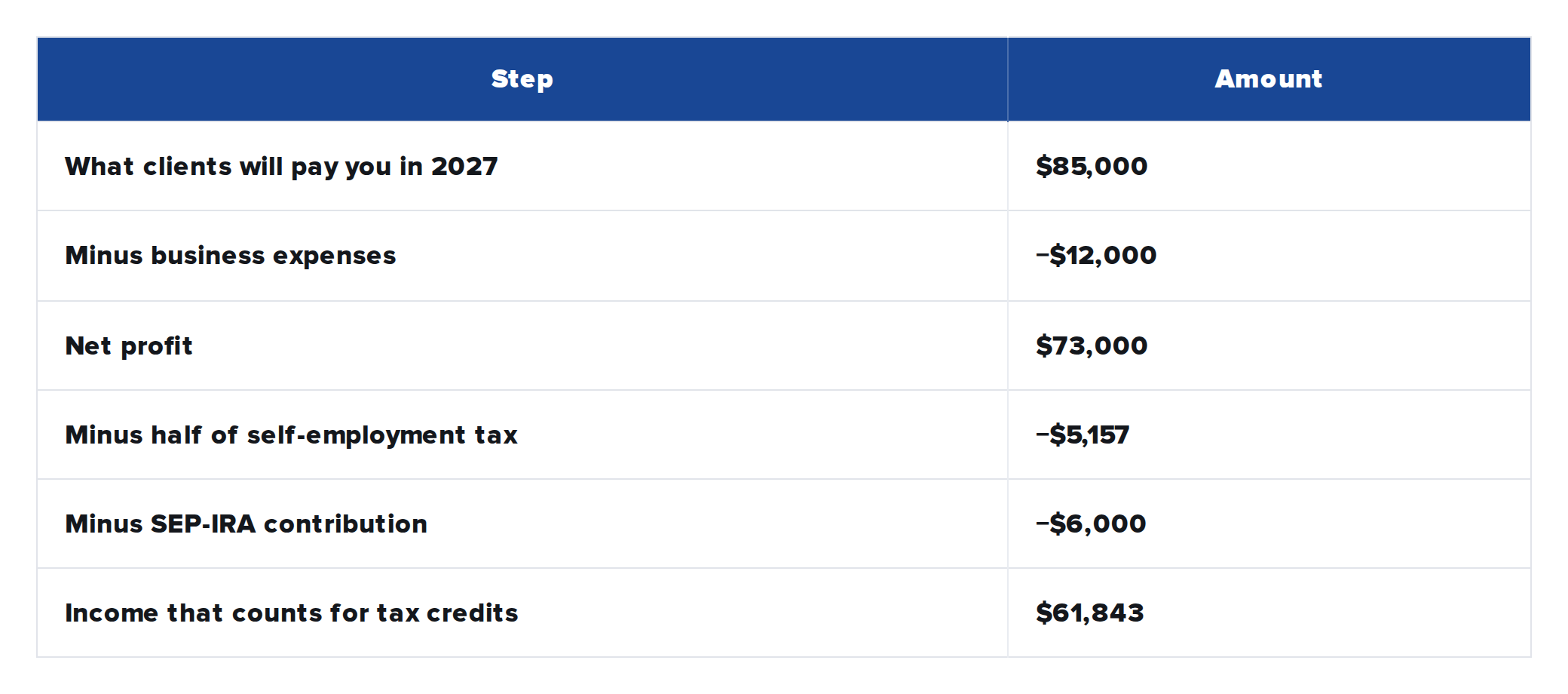
That’s under the $63,840 limit, so this designer can qualify for tax credits. Without the SEP-IRA contribution, their countable income would be $67,843, over the limit, with no help at all. (These are example numbers. Your tax professional can check yours.)
3 Ways to Protect Yourself From a Surprise Tax Bill
1. Estimate realistically, and lean a little high if you’re unsure. If you overestimate, you get a bit less help each month, but you get the difference back as a refund at tax time. If you underestimate, you’ll owe it back. A small refund beats a big bill.
2. Take less of your tax credit upfront. You don’t have to apply your full tax credit to your monthly premium. You can choose to use part of it now and claim the rest when you file your taxes. That builds in a cushion if you have a great year.
3. Check in every quarter. You’re probably already paying quarterly estimated taxes. Use those same four dates to compare what you’ve actually earned to your estimate, and update it if you’re off.
When Your Income Changes Mid-Year
Landed a big new client? Lost one? Log in to Connect for Health Colorado and update your income as soon as possible, ideally within 30 days. Your tax credit will adjust for the rest of the year, which keeps your tax-time surprise small.
What Happens at Tax Time
In early 2028, you’ll get a Form 1095-A showing the tax credits you received for 2027. When you file, you or your tax preparer compare that to what you actually qualified for, based on your real income:
- Earned less than you estimated? You get the extra credit back as a refund.
- Earned more? You pay back the difference, with no cap.
- Ended the year over the 400% limit? You pay back every dollar of tax credits you received. This is where freelancers near the line get hurt most, so watch your income closely in the fall.
Keep your invoices, expense records and retirement contributions organized all year. It makes this step much easier.
The bottom line
You don’t need a crystal ball. Start with last year’s net profit, adjust for what you know, subtract your expenses and adjustments, and lean a little high if you’re unsure. Then update your estimate whenever your income changes.
We work with freelancers and self-employed Coloradans every day. We’ll help you build a realistic estimate, show you how close you are to the tax credit limit, and compare Marketplace plans, fixed indemnity and health shares so you get the best deal for how you actually earn.
Book a free call or call 303-225-0073. It’s always free to work with us.